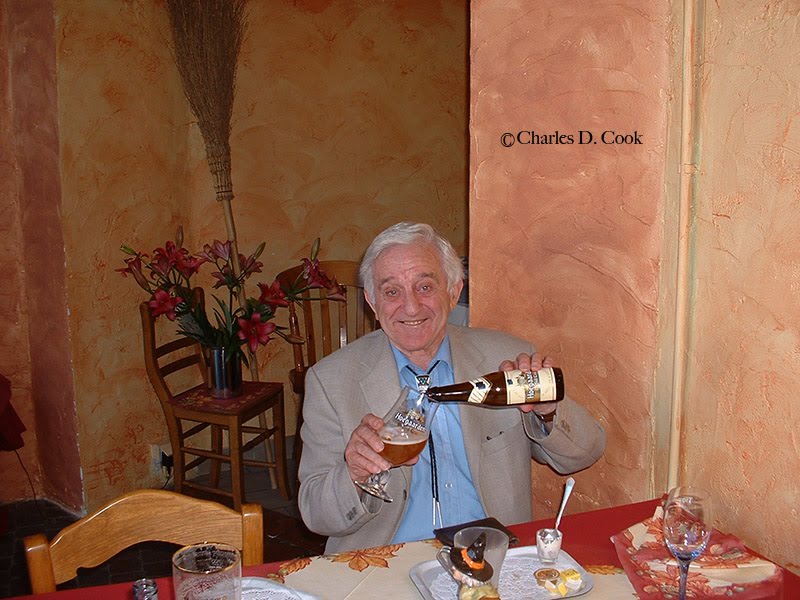
(Photo, above: Pierre pouring a Hoegaarden Grand Cru
in a cafe in Hoegaarden, 2003.)
Pierre Celis: a Conversation in Hoegaarden
Most of you will have heard by now of the passing of beer legend Pierre Celis on Saturday, April 9 at his home in Hoegaarden, Belgium.
I met Pierre at New Belgium Brewing in Fort Collins, Colorado during GABF week in late September 2003. He extended me an invitation to come interview him in Hoegaarden, and I did so less than three weeks later.
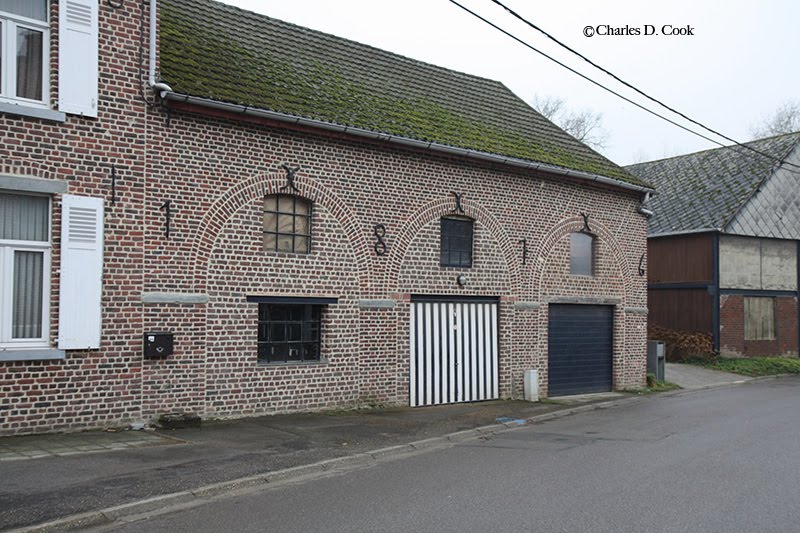
Pierre came to meet me in Leuven on October 17th of that year, and we took a train to Tienen, the closest station to Hoegaarden. He then drove us to his hometown, showing me many the old buildings in the village that used to be breweries. Many were marked with dates in stone blocks, some dating to the 18th century.
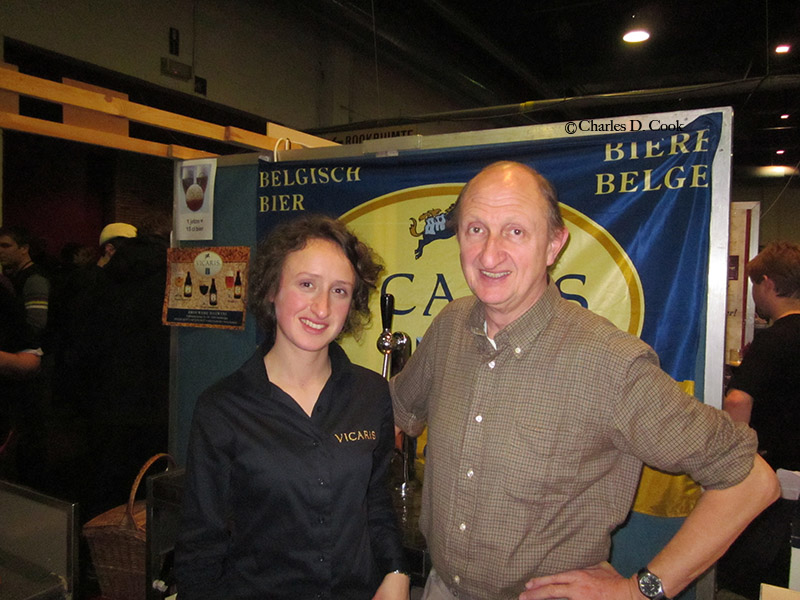
 (Photo, above: your truly (left) and Pierre at
Abbaye Notre Dame de St-Remy.)
We had lunch at a local café, enjoyed with a Hoegaarden Grand Cru, as Pierre regaled me with stories from the past. We then toured his original brewery, and I interviewed him in his home office.

 (Photos, above: Pierre's home in Hoegaarden.)
Eleven days later, Pierre joined me again as I toured Brasserie
Rochefort at Abbaye Notre Dame de St-Remy. The photo of Pierre and
I, above, was taken by a friend using my camera, in the abbey.
Below is an article I wrote that was originally published in 2005. I hope you enjoy it.
Belgian witbier, or white beer, is a very refreshing and thirst-quenching style of brew, especially during the heat of the summer. It is also a great session beer. Amazingly, white beer was a dead style back in the early 1960’s.
Fortunately for the beer lovers of the world, Pierre Celis resurrected witbier in 1966, when he opened Brouwerij Celis in the Belgian town of Hoegaarden, the ancestral home of witbier.

(Photo, above: the copper vessel Pierre used to brew his
first homebrewed test batches in 1965.)
Being a fan of the style, I wanted to learn the history behind it, and Pierre Celis’ involvement with it. In 2003, he granted me an interview, and a visit to his original brewery, which is located in an old stable behind his family’s home on Stoopkensstraat. The open mash tun and copper brew kettles are still there.


(Photo, above: Pierre at the open mash tun in his original
brewery in the stables behind his home, and the inside of
this mash tun.)
As a child and teenager, Pierre worked at the Tomsin brewery, which was the last producer of witbier in Belgium. The brewery, which closed in 1957, was located just across the street from his home. “I grew up on the same street. I worked at Tomsin from an early age. At the beginning of World War II, there were still three witbier breweries left in Hoegaarden. But the beer from Tomsin was the best,” Pierre commented.
The Tomsin brewery was torn down years ago.
“When you came to the brewery, there was always a keg, and you could drink. The early white beers were probably only 3 or 4% alcohol, but we don’t know for sure,” he added.
Interestingly, Pierre says that, to the best of his knowledge, none of his ancestors were brewers. His family has always been in the beef and dairy business, as far as he could recall. Pierre’s father owned a dairy, and Pierre delivered milk.


(Photos, above: these copper brewkettles were on the second floor of
the stables. You had to use a ladder to get to this space...even in 2003!)
Many witbiers have a spicy character due to the use of spices such as coriander and curacao (bitter orange peel.) The history of white beer can be documented as far back as the 14th century. Historical records show that there were a dozen breweries in Hoegaarden in 1709, with the number jumping to 30 by 1745. This, for a village of only 2,000 people!
Fifty years later, there were 3,000 inhabitants in the town, with 35 breweries-and one pub for every ten inhabitants! By 1880, there were still 13 breweries in the town, almost all producing white beer. In 1914, just six remained.
Hoegaarden at present has a population of over 6,000, with just two breweries. There is the internationally known Hoegaarden, owned by InBev, as well as newcomer Hoegaarden Nieuwhuys. Hoegaarden’s “New House” is a brewpub producing a number of fine beers, which opened in 2006.

(Photo, above: the old Brasserie Loriers in Hoegaarden.)
There are many large, empty buildings in the town that were once breweries. Many still have their names and dates carved into stone, and several are from the 1700’s. Would those past brewers believe that Witbier and Hoegaarden are now known throughout the beer-drinking world? “You see what beer can do,” Pierre commented.

(Photo, above: this brewery was dated 1753. I can't recall which
one Pierre said it was.)
What made Hoegaarden the perfect location for the brewing of this style of beer? “Hard water (calcium-rich water) is good for brewing a wheat beer. Also, there were abundant supplies of water in the area. I have a well at my home,” Pierre said. “There were also hops and grain in the area. There were wild hops growing in the area, and there still are. You can see some in the ditches on the sides of the road, below street level.”

(Photo, above: an old Tomsin brewery advertising plaque.)
Pierre used the original recipe for the Tomsin beer, as he remembered it, when he started his brewery, at the age of 40. What led him to do so? Pierre said, “I was having a few beers with friends in the early 1960’s. I was a milkman by profession. My friends and I lamented that there was no more witbier in the world. They told me, jokingly, that I should make another frothy white beverage: beer! I started thinking: why not?”
As to the recipe, he told me: “I never used Belgian hops, though Tomsin used them sometimes. I needed aromatic hops, not bittering hops. The aromatic hops were not grown much in Belgium by then. They produce less per hectare than bittering hops. I often used Kent Goldings, from the U.K. or Czech Republic. Also, while Tomsin used oats to add to the cloudiness of the beer, I found that mixing oats and spelt was better. Of course, most of the cloudiness from the early beers brewed in Hoegaarden was due to infection, or mistakes. Often, the beers were only drinkable for about three weeks, depending on the time of year. After that, they became more and more sour,” Pierre explained. “The drinking vessels were porcelain in the old days, so you could not see the beer as much anyway.”
The eponymous Hoegaarden glass of today was purely a creation of Pierre: it was patterned after an old glass he saw in the living history museum at nearby Bokrijk, where the old Tomsin brewery equipment now resides. In fact, it may have been a glass used for drinking milk! Pierre added that witbier was served at about 12 degrees celsius (54 F) in the old days.
Of course, coriander and curacao/bitter orange peel were an important part of the Tomsin beers, and Pierre experimented with different types to find the ones he liked best in his new Hoegaarden beer: “I liked to experiment with fermentation, ingredients, or whatever I thought might improve my beer,” Pierre said. “I think the most important thing is always quality. If you have no quality, it is always the same thing: you are short term. Fancy labels and marketing must come after the quality of the beer is there.”

Of course, Pierre has always been a shrewd marketer. He made over one million “Identiteitskaart Van Bierdrinker” (Identity Card of the Beer Drinker) cards, which looked similar to the Belgian driver’s licenses of the time. The card was issued by “The Beer Kingdom of Hoegaarden”, and the beerdrinker on the one I have is De Verboden Vrucht, born at Brouwerij De Kluis on November 4, 1982. He is said to be dark red, with a strength of 8% alcohol!
Pierre first brewed his new witbier in 1965, allowing his friends and neighbors to try the beer and comment on it. At a certain point everyone agreed that he had nailed the taste as they remembered it. He opened Brouwerij Celis officially on March 16, 1966, and produced 350 hl that year. By 1978, production of Hoegaarden beer was 1,975 hl. In 1968, he started bottling the beer (which at first was only put in kegs) using simple labels from a local printer, with the letters “HW” in black and red.
In 1969, the first Hoegaarden Grand Cru was brewed. Pierre told me: “Sales of white beer were lower in the winter. People wanted a strong beer during the cold weather, so I started with the Grand Cru, at 7.5% abv. It was an immediate success.”

(Photo, above: the entrance to the Hoegaarden brewery. This was
Brouwerij Hoegaarden De Kluis when Pierre owned it.)
By 1978, he needed to expand, and purchased the De Kluis water and soft drinks factory in town, and converted it to a brewery, installing a new 100 hl brewkettle. It opened July 19, 1979. Pierre explained: “Once my beer became a success, every brewery in Belgium started brewing a white beer. I had to grow to be able to compete, and I still brewed at home even after opening the De Kluis brewery.” The De Kluis brewery was rebuilt after a 1985 fire, and is what we all know now as the Hoegaarden brewery.

(Photo, above: old wooden crates and a barrel in the Hoegaarden
brewery.)
Noting the problem with lactobacillus infections in witbiers, Pierre said that 1979 was a very important year: “I started using flash-pasteurization then. This solved the problem. The beers had far better long term drinkability after this.”
Pierre started exporting his beer to the U.S. from an early date: “I was invited to a Belgian trade show and market in Atlanta in 1974. It was my first trip to America. I did not speak any English. But I thought I could sell my beer in America, as everyone was drinking the same kinds of boring lagers. It was my dream to open a brewery in America,” which was later realized, of course, with the Celis Brewery in Austin, Texas.
“I contacted Mannekin-Brussel Imports in 1974 or ‘75. They started importing Hoegaarden, mainly for Texas, in 1975, and continued doing so until 1985. That is the year the De Kluis brewery burned down” Pierre said.
Unfortunately, Pierre’s brewery was under-insured, with only 40 million Belgian francs of coverage, when 280 million were needed to rebuild: “I did not have the money to rebuild, and Stella Artois (now InBev) offered to invest, in return for 45% of the shares. I entered an agreement with them, and continued to run the brewery for a few years. In 1988, a merger between Stella Artois and Piedboeuf created Interbrew,” Pierre sighed. “That’s when things went downhill. The bankers wanted to take over and cheapen the ingredients used in my beers. I resisted for a while, but finally, in 1990, I sold the rest of my shares to Interbrew. I was 65, and didn’t want to fight with the bankers anymore.”
Pierre had dreamed of opening a brewery in America for years. While Belgian colleagues told him white beer would never sell in this country, he was convinced otherwise: “I went to bars in America and talked to beer drinkers. I asked them how they liked their beer. Many said it was watery and tasteless. I thought there was a market for witbier there.”
Pierre continued: “Beer drinkers are curious about other beers. If you drink a cloudy beer, and another drinker has never seen a beer like this before, they ask what you are drinking. Word of mouth is a big seller.”

(Photo, above: mementos in Pierre's office, behind his home.)
Of course, he was right. Pierre searched for an area to open a new brewery in the U.S. He liked Texas for a variety of reasons. Austin has hard water, very similar to that of Hoegaarden. Also, he told me that Texans spoke very slowly, and Pierre could understand them better than other Americans. People in Austin were very receptive to a new brewery, and he settled on that city for the new venture. In 1990, he gave his specifications to an architect for the new Celis brewery, which opened in 1992. Pierre did not have to advertise at first, as he received extensive coverage in the local newspapers and television. Later, he did some radio ads.
His distributor did very well getting new accounts for his beers, the first of them being Maggie Mae’s in Austin, which is still going strong. After a year, he was already sending Celis White to six states, and many more would come in the future. One of these was North Carolina, where I purchased my first six of pack Celis White from a grocery store around ‘94 or 95. I was hooked immediately.
Celis brewery production was growing very quickly, from 3,000 barrels of beer the first year, to almost 23,000 in 1997. This would eventually, and unfortunately, lead to its downfall. The brewers and workers of the Celis brewery, with the huge demand for their beers in the U.S., wanted to expand, with bigger and better equipment. They were given the money to do so, for a time.
Eventually, Pierre’s partners in the Celis brewery venture, with 45% of the stock, got cold feet and wanted out. They were concerned about getting their investment out the brewery, without waiting many years to do so. They first offered their shares to Pierre, but his money was tied up in his controlling stake. So the other investors sold their stock to Miller Brewing: “At that point, I was married to Miller. But not by my choice. Then I made a mistake. I let them take over management of the brewery,” Pierre lamented.
Obviously, things did not work out. Miller offered to sell the brewery back to Pierre in 2000. However, at 75 years of age at the time, he did not want to risk such an investment.
Michigan Brewing co. now owns the Celis brand name in the U.S., as well as the original brewing equipment. Pierre owns the Celis brand in Europe, and has Celis White brewed at Van Steenberge for the Belgian market.

One of the last beers Pierre Celis helped perfect was St. Bernardus Witbier, from the great brewery in Watou. He cooperated with Hans Depypere, brewmaster of St. Bernardus, on the recipe. He also helped develop Grottenbier, a dark brown cave-aged beer brewed by St. Bernardus. It was the brainchild of Pierre’s many trips to the Champagne region of France.
I visited St. Bernardus on February 28th of this year.

Also, Les Trois Fourquets, a brewpub in Courtil-Gouvy, Luxembourg Province, welcomed Pierre in April 2005. He helped oversee the brewing of a batch of “Celisette” by brewer Pierre Gobron. It was made to the original recipe of Hoegaarden Grand Cru, and was released at a beer fest in Antwerp that June, with Pierre and Michael Jackson present.
Pierre’s efforts have led to witbier becoming a common sight at watering holes across Belgium, the U.S. and other countries. Dozens of Belgian breweries, as well as brewpubs and microbreweries around the world, now produce their own versions of this excellent brew. The world of good beer is far better for it. Grand Cru will always be remembered for its originator, and is a much copied, and much loved, style as well.
What will happen to the brewery and stables where witbier was resurrected in 1965? Only time will tell, but in my opinion, it should be preserved as a Belgian national historic site. Rest in Peace, Pierre, and dank u wel for bringing witbier back to the world.