Wednesday, May 25, 2011

Gueuzerie Tilquin

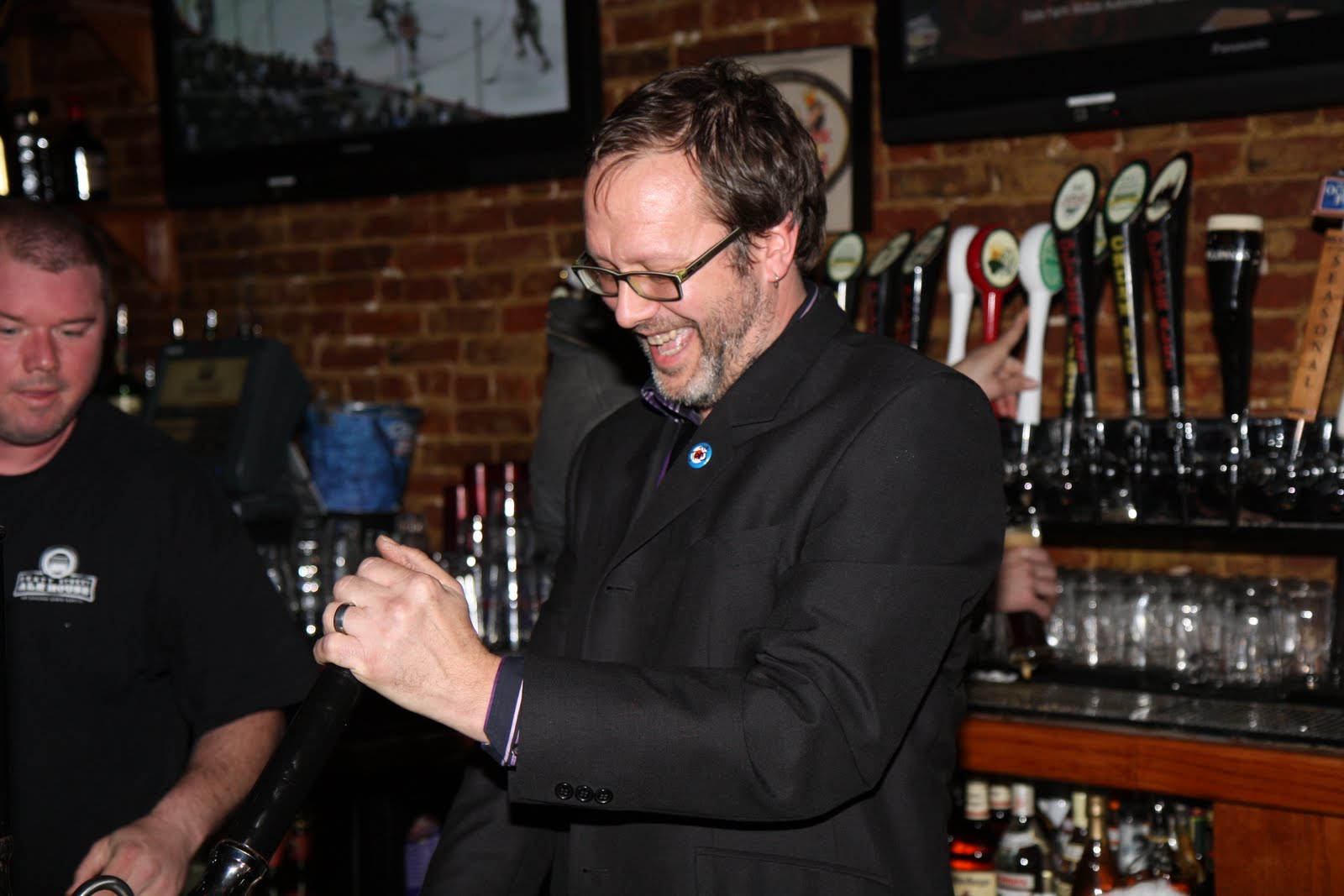
(Photo, above: Pierre Tilquin pouring a sample of
lambic in the blendery.)

This Saturday and Sunday, May 28-29, Belgium's first new
lambic blendery in nearly 15 years will open its doors to the public
for the first time, from 10 am-6 pm. Yes, sour beer lovers,
Gueuzerie Tilquin has arrived, and is ready to show off its
brews.

The mastermind and driving force behind the project is
Pierre Tilqiun, 37, who was educated as a bioengineer.
Tilquin holds a Ph.D. in statistics and genetics.


The following Friday, June 3, will be the official debut of Oude
Gueuze Tilquin a l'Ancienne, in 37.5 and 75 cl bottles and on draft.

The event will happen at both locations of Moeder Lambic in
Brussels, as well as Delirium Taphouse, starting at 4 pm (16.00)
local time. Delirium Cafe, the bar with 2,000 beers located below
the Taphouse, will have bottles on offer beginning at 10 am for
those who are too thirsty to wait till late afternoon, and Pierre
will be at on hand at the Taphouse at 10 PM (22.00) to present his
Oude Gueuze and answer questions.

I really wish I was in Belgium next weekend . And this one too.


Tom Peters of Monk's cafe in Belgium plans to join the fun,
albeit a continent away. Peters says he will offer a sneak
preview with a very limited number of bottles of the Oude
Gueuze at Monk's. He will crack the first bottle at
12:01 PM that same day, which is also opening day of
Philly Beer Week 2011.


(Photo, above: Tom Peters likes his lambic in large
quantities, as shown in this photo at Moeder Lambic
Fontainas in March.)

I imagine Monk's might get a bit busy that day.

If I was in Belgium, I know where I would be!

Also, this weekend is the Weekend of Spontaneous
Fermentation in Buggenhout, arguably Belgium's top
lambic beer fest. I attended in 2008 and 2010, and look
forward to getting back in the future.


(Photo, above: inside the hall at the Weekend of
Spontaneous Fermentation Beer festival.)


This is the 20th Anniversary of the event. The beer
appreciation club that organizes the fest,
De Opstalse Bierpallieters, asked Brouwerij Girardin
to produce a special Oude Gueuze for them, and indeed
they did.


I'm fortunate to have tasted one a couple of weeks
ago, and it was very good. Only 1400 bottles were filled.
It will debut and be available at the event.
See: Weekend

I visited Gueuzerie Tilquin on May 29, 2010.

Here's an article that first appeared in Celebrator Beer News
last August:

Belgium has a new gueuze blendery, and it’s in Wallonia.

Lambic and gueuze beers, those produced in the Payottenland, an area to the south and west of Brussels, have been gaining in popularity and respect for a number of years now. Making traditional lambic brews, created by spontaneous fermentation and aged in oak barrels, is a tough business, requiring lots of initial investment and patience, as the production process can take years. Lambics of various ages are blended to make gueuze.


(Photo, above: Pierre Tilquin in his blendery.)

Fortunately for the sour beer lovers of the world, there are young Belgian beer lovers dedicated to the survival and promotion of such brews. Pierre Tilquin is one of them. He and a small group of investors have started the first new gueuze blendery in “The Beer Country” since Geuzestekerij De Cam opened in 1997.

Gueuzerie Tilquin is also the only lambic blendery in Wallonia. However, Flanders is barely a couple of football fields away.


“We opened in March 2009,” Pierre told me during my visit to the blendery on May 29th. “We have 222 barrels, all in the 400 liter size, and all are full now,” he added. “So that’s 888 hectos of lambic on barrel.”

Opening a new blendery is a very big deal, as the initial investment in time and money is huge, with little financial return until the first bottle of Oude Gueuze is sold, years later. To take on such a venture requires someone with a lot of vision, patience and determination.

“I worked at with Armand (Debelder) at 3 Fonteinen for six months, and at Cantillon for six months as well,” Pierre told me. “I learned a lot from these two great blenders, and got different perspectives from each. It was very valuable experience. My idea is to take the best of both worlds,” he added.

He continued: “As I live in Brussels, I did want to open a blendery there. But rents are very high, and it was impossible to find a suitable space at a reasonable price. Here in Bierghes-Rebecq, we are only about 15 minutes driving from Lembeek, where Brouwerij Boon is, and Flanders is about 200 meters away.”


Pierre also mentioned the government helps businesses such as his in Wallonia, whereas such subsidies are rarely seen in Flanders. Adding to that, he said “We have a great deal of time and money already invested here. All the barrels are from French wineries; 150 of them, with the silver bands, come from the St. Emilion and Medoc regions, and cost us 70 Euros each. The other 72, with the black bands, come from the Hermitage region, and we paid 60 Euros each for them.” Pierre added that he cleaned the barrels with hot water until no color remained in them.

“I have backing and help from Gregory Verhelst of Brasserie La Rulles, and other investors. We have a complete business plan. I will work at the blendery full time, and we may have another person working part time as well in the future,” Pierre commented.

“Of course you know all lambic producers have their own symbol, which you can see painted on their barrels. I’m still working on mine, as well as a website,” Pierre remarked.

When will the sour beer lovers of the world be able to taste that first Gueuzerie Tilquin beer, you ask? “We will release our first gueuze, which will likely be called Oude Gueuze Tilquin à l'Ancienne, in May or June, 2011. It will be a blend of one and two year-old lambics,” Pierre told me. “I’d like to wait till 2012 and do a 1, 2, and 3 year old Oude Gueuze, but we need some return on our investment, and cannot wait until then. In 2012, we will have a three year old lambic in the blend,” he added.


“My plan is to sell 500 hl of blended lambics and Oude Gueuze per year. For that you need about 900 hl of barrel capacity, which we have. We buy wort from Boon, Cantillon, Girardin, and Lindemans, and put them in our barrels here. But I won’t sell any straight, unblended lambic; there’s no reason to when you could buy that right from the breweries. I’ll sell only some blended lambics on draft at special places like Moeder Lambic and Delirium Cafe in Brussels, and of course 37.5 cl and 75 cl corked bottles of Oude Gueuze. I even have some ideas for fruit beers for the future, but it won’t be Kriek or Framboise, as these are already common. I want to do something different.”

Pierre continued: “As to Cantillon lambic, I will only use it in my blends as a three year-old. In fact, I’m the first and only gueuze blender that Cantillon will sell their wort to. I’ll probably use Boon as a one year-old, and Girardin and Lindemans as one, two, or three year old lambics.”

Ah, and the taste, you ask. We first sampled an interesting “March” beer from Boon which was just a few months old. It was an interesting brew; a lightly sour beer of 8 degrees plato and about 3% abv that Pierre told me he would used to lower the alcohol in his Oude Gueuze. “My goal is a gueuze of about 5 to 6% abv. I don’t want it to be higher than that. This March beer is what the farm workers would have drunk in the fields years ago. Refreshing, but not too alcoholic,” Pierre said.

Moving up the ladder a bit, we then tasted a 14 month old lambic from Lindemans that was very nice. It was getting its funk on, and was already a very pleasing, tart beer. We then tasted a Boon of the same age, which was equally as good. Having tasted lambics right from the barrels at all the lambic breweries and blenderies in the Payottenland (except the Inbev plant) I was very impressed.


Pierre told me that the temperature inside the blendery is controlled so that it won’t go higher than 19 C (66 F) in summer. He added, “What you see here is only the beginning. I still have to build a warm room for conditioning the beers, and also a room for the bottling machine.”

I can’t wait till next summer arrives and the first Gueuzerie Tilquin Oude Gueuze is ready to drink! I think a lot of beer lovers are likely to feel the same. Sante, Pierre, and see you next year. (end of last year's article.)

Note that the bottling line has been installed, obviously.


(Photo, above: Pierre Tilquin and Brian Ewing,
at Moeder Lambic Fontainas in March.

Brian Ewing and 12 Percent Imports will import Oude
Gueuze Tilquin a l'Ancienne to the U.S.A.

Sunday, May 15, 2011

"Ladies in the House" Belgium's female brewers in Taps Magazine


Here's some love for the ladies.

I have a 1,200 word article about several of Belgium's female
brewers in the Spring issue of Taps: The Beer Magazine.


Covered are Anne De Ryck, brewmaster of Brouwerij de Ryck in
Herzele, East Flanders, and her daughter, Mieke van Melkebeke.
Mieke shares brewing duties as well as handling sales and marketing.
De Ryck's Arend Tripel is avaiable stateside.


(Photo, above: Mieke van Melkebeke and Anne de Ryck,
Brouwerij de Ryck.)

Annick ("Nicki") Desplenter of Gent's Stadsbrouwerij Gruut is also
featured, as is Natalie Eloir of Brasserie de la Abbaye de Rocs in
Hainaut Province, Wallonia.


(Photo, above: Nicki Desplenter, Gent's Stadsbrouwerij Gruut.)

Belgium's newest female brewer, Anne-Cathérine Dilewyns,
also has a brand new brewery to showcase her beers.
Brouwerij Dilewyns first brewed in March, and their first open
house will be Saturday, May 21st.


(Photo, above: Anne-Cathérine Dilewyns,
Brouwerij Dilewyns.)

The Dilewyns brews are labeled Vicaris and will be imported into
the U.S. by Vanberg and Dewulf. See here for more info.

Copies of Taps can be purchased at Barnes and Noble
and Borders stores as well as on the website


(Photo, above: Natalie Eloir, Brasserie de la
Abbaye de Rocs.)

Tuesday, May 10, 2011

Cask Ale fest at Pratt Street Alehouse this Saturday


(Photo, above: Steve Jones, Brewmaster, Pratt Street Alehouse.
Yeah, I know his t-shirt says Stillwater Artisanal..
it was a collaboration day....for beer and t-shirts.)

Pratt Street Alehouse (Oliver's beers) will hold it's
Chesapeake Real Ale fest this Saturday.

Well, it's not Belgian beer, but there are some Belgian-inspired
beauties on the list, nonetheless.

Not to mention that fact that Pratt Street Alehouse brewmaster
Steve Jones will have some goodies to show off on his home turf.


(Photo, above: Steve Jones pulling a cask pint behind
the bar at Pratt Street Alehouse.)

Here are the details:

May 14th 1-6, Noon for VIP

$40 Unlimited Sampling

$60 VIP, Noon entry, food tickets, Free T-Shirt

Great Food Options
Rain or Shine
Live Music All Day – Black Falls (Blues), Caffeine (Acoustic Mix)

See: Real Ale for ticket info.

Pratt Street Ale House
206 W. Pratt St., Baltimore, Md. 21201

Cask line Up:

Stone Ruination IPA

Evolution lot 6 double IPA + pin bacon porter (!)

Oskar Blues Dales Pale Ale dry hopped cascade

Mamas Little Yella Pils w/ rosehips

Old Chub w/ coconut

Weyerbacher Blanche

Flying Fish Exit 4 w/ centennial & citra (hopefully one more also)

Brewer's Art Resurrection

Stillwater/Brewer's Art Debutante

Stillwater beaujolais cask Existent (for VIP hour)

Troegs Javahead Stout

Great Divide Yeti

Heavy Seas Loose cannon Red, White & Birch (red oak/white oak/birch)

Stoudts Heifer-in-wheat w/ kumquat

Yards Saison

The Raven Lager

Flying Dog Gonzo on oak

Single hop Imperial IPA

Breckenridge x 2

White Marsh 1 or 2

Brewer's Alley

DuClaw 2010 Devil's Milk aged in Jack Daniels Whiskey Barrel

Dog Java stout with French oak

Oliver’s Hot Monkey Love batch #2 drawn directly from oak barrel (aged 10 months)

Stillwater Channel Crossing #4 dry hopped w/ tettnanger beaujolais cask

"Draft Punk" w/ Juniper & honey (for VIP hour)

Pagan Porter with vanilla

BrewDog paradox Isle of Arran

OK, I'm back. Here's how I see it...

Three Stillwater casks and a whole lot or other goodies.
I'm thinking this is going to be a fun day.
Come on out and join us and have a great time.

Wednesday, May 4, 2011

Vanberg and Dewulf tasting in D.C.


(Photo, above: from left, Wendy Littlefield, Don Feinberg
and Greg Engert.)

On this past Monday night, I attended a tasting at Birch
and Barley in Washington, D.C.


Belgian beer importers Don Feinberg and Wendy Littlefield of
Vanberg and Dewulf spoke about how they got into the importing
biz and about many of the great beers they bring into the U.S.


Birch and Barley/Church Key Beer Director Greg Engert spoke
about the various food pairings crafted by he and Executive
Chef Kyle Bailey.


(Photo, above: Executive Chef Kyle Bailey and
Wendy Littlefield.)


Highlights included a 2 year old keg of Lambrucha (yum,
seriously...it is incredible how well this 3.5% abv brew
had aged) as well as Dupont's 2011 Avril and several other
brews, including Scaldis (Bush) de Nuits from Brasserie
Dubuisson, a 13% abv treat.

Don and Wendy plan on doing many more tasting events across
the U.S.A. in 2011 and 2012, as they began importing Belgian
beer in 1982. Cheers!

Tuesday, April 26, 2011

Vanberg and Dewulf tasting at Birch and Barley In D.C. May 2nd


Don Feinberg and Wendy Littlefield, the pair who founded
Vanberg and DeWulf importers in 1982, will be at Washington,
D.C.'s Birch and Barley and Church Key for a tasting on Monday,
May 2nd.

This from Church Key/B&B Beer Director Greg Engert:

"Don and Wendy will speak about their lives in beer and the
brewers and beers we feature! The Birch & Barley chef
will send out small Belgian-inspired bites w/ which to pair
a number of beers with."

The tasting will be held from 7 to 10 pm at Birch and Barley,
and the lineup is as follows:


LAMBRUCHA (Brouwerij de Troch) on tap, 30 liter keg


HOP RUITER (De Scheldebrouwerij) on tap, 30 liter keg


SCALDIS PRESTIGE DES NUITS (Brasserie Dubuisson)
in 750 ml bottle size


CASTELAIN BIERE DE GARDE 750 ml bottle size


DUPONT AVRIL 750 ml bottle size


DUPONT SAISON 750 ml bottle size


DUPONT BIERE DE MIEL 750 ml bottle size

Cost is $45 not including tax and gratuity.

See: http://www.birchandbarley.com

Lambrucha was my favorite new Belgian beer of 2010.

I wrote this about Lambrucha last year:

“Lambrucha,” a blend of Belgian lambic beer and Kombucha tea,
first debuted in Chicago in early spring.
Kombucha is a tart, effervescent
tea created by adding a culture, sometimes called a mushroom, to a base
tea. This “mushroom” is full of microorganisms, and looks somewhat like
a large pancake. The “mushroom” contains a number of different yeast
strains, including variants of Brettanomyces and Pediococcus. Kombucha
is thought to have beneficial health benefits by many cultures, especially
in its homeland of the Central Asian steppes.


(Photo, above: an active barrel at Brouwerij De Troch.)

“This remarkably enlivening thirst-quencher is a proprietary blend
of two living drinks” Don Feinberg of Vanberg and Dewulf told me
in April. He continued “Lambrucha is, to our knowledge, the first
time two different types of live yeast drinks have been blended
together to create a completely new live yeast beverage.”


(Photo, above: pulling lambic from a barrel at
Brouwerij de Troch.)

“Dr. Roger Mussche, the Gent-based brewing scientist who
is the world’s leading authority on Brettanomyces yeast, helped
me with this project” Don told me. “It was bottled at Brouwerij
De Troch in Wambeek, one of the lambic breweries in Belgium’s
Payottenland. Lambrucha combines hand-selected lambics that are
at minimum one year old, and batches of specially-brewed organic
Belgian Kombucha,” he added.


In a tasting with several friends, we found Lambrucha to be as
advertised: tart, refreshing, herbal and floral, with perhaps
hints
of rosemary and hibiscus. At only 3.5% abv, you could practically
drink it all day.
In fact I would if I could.

I've never had this beer on tap before, so this should be a treat!

In addition to the beers in this tasting, many of Church Key's
taps will be dedicated to beers imported by Don and Wendy
on Monday...so it should be a great night to go to do some beer
tasting!

Don and Wendy have spent the last six or so weeks in Belgium
and other European spots looking for more breweries and beers
to add to their portfolio.


These include Dupont's Redor Pils, Biere de Beloeil, Cervesia
(renamed Posta Rustica for the U.S.) Foret Blanche, and Monk's
Stout.


There are also a number of other brews in the works that
I will write about in the near future.

See: Vanberg & Dewulf for more info.

Wednesday, April 20, 2011

Pierre Celis: A Conversation in Hoegaarden


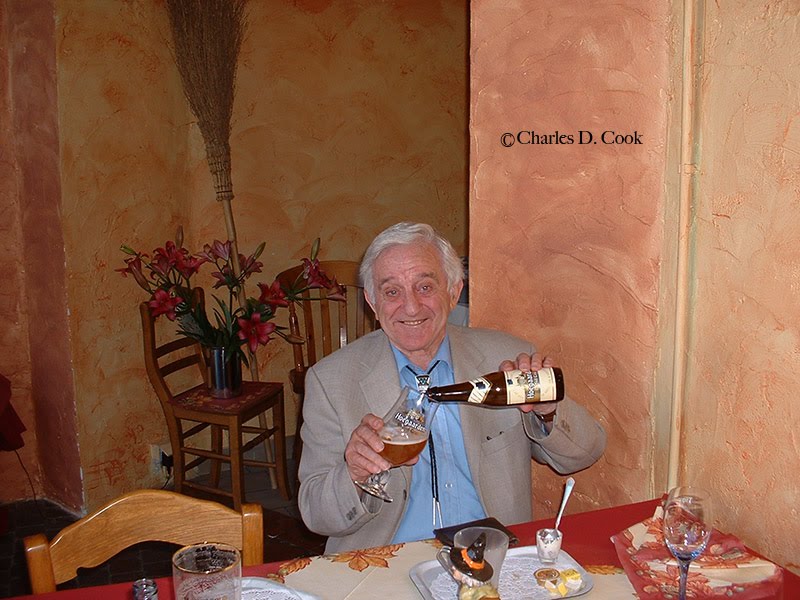
(Photo, above: Pierre pouring a Hoegaarden Grand Cru
in a cafe in Hoegaarden, 2003.)

Pierre Celis: a Conversation in Hoegaarden

Most of you will have heard by now of the passing of beer legend Pierre Celis on Saturday, April 9 at his home in Hoegaarden, Belgium.

I met Pierre at New Belgium Brewing in Fort Collins, Colorado during GABF week in late September 2003. He extended me an invitation to come interview him in Hoegaarden, and I did so less than three weeks later.

Pierre came to meet me in Leuven on October 17th of that year, and we took a train to Tienen, the closest station to Hoegaarden. He then drove us to his hometown, showing me many the old buildings in the village that used to be breweries. Many were marked with dates in stone blocks, some dating to the 18th century.

(Photo, above: your truly (left) and Pierre at
Abbaye Notre Dame de St-Remy.)

We had lunch at a local café, enjoyed with a Hoegaarden Grand Cru, as Pierre regaled me with stories from the past. We then toured his original brewery, and I interviewed him in his home office.


(Photos, above: Pierre's home in Hoegaarden.)

Eleven days later, Pierre joined me again as I toured Brasserie
Rochefort at Abbaye Notre Dame de St-Remy. The photo of Pierre and
I, above, was taken by a friend using my camera, in the abbey.

Below is an article I wrote that was originally published in 2005. I hope you enjoy it.

Belgian witbier, or white beer, is a very refreshing and thirst-quenching style of brew, especially during the heat of the summer. It is also a great session beer. Amazingly, white beer was a dead style back in the early 1960’s.

Fortunately for the beer lovers of the world, Pierre Celis resurrected witbier in 1966, when he opened Brouwerij Celis in the Belgian town of Hoegaarden, the ancestral home of witbier.


(Photo, above: the copper vessel Pierre used to brew his
first homebrewed test batches in 1965.)

Being a fan of the style, I wanted to learn the history behind it, and Pierre Celis’ involvement with it. In 2003, he granted me an interview, and a visit to his original brewery, which is located in an old stable behind his family’s home on Stoopkensstraat. The open mash tun and copper brew kettles are still there.


(Photo, above: Pierre at the open mash tun in his original
brewery in the stables behind his home, and the inside of
this mash tun.)

As a child and teenager, Pierre worked at the Tomsin brewery, which was the last producer of witbier in Belgium. The brewery, which closed in 1957, was located just across the street from his home. “I grew up on the same street. I worked at Tomsin from an early age. At the beginning of World War II, there were still three witbier breweries left in Hoegaarden. But the beer from Tomsin was the best,” Pierre commented.

The Tomsin brewery was torn down years ago.

“When you came to the brewery, there was always a keg, and you could drink. The early white beers were probably only 3 or 4% alcohol, but we don’t know for sure,” he added.
Interestingly, Pierre says that, to the best of his knowledge, none of his ancestors were brewers. His family has always been in the beef and dairy business, as far as he could recall. Pierre’s father owned a dairy, and Pierre delivered milk.


(Photos, above: these copper brewkettles were on the second floor of
the stables. You had to use a ladder to get to this space...even in 2003!)

Many witbiers have a spicy character due to the use of spices such as coriander and curacao (bitter orange peel.) The history of white beer can be documented as far back as the 14th century. Historical records show that there were a dozen breweries in Hoegaarden in 1709, with the number jumping to 30 by 1745. This, for a village of only 2,000 people!

Fifty years later, there were 3,000 inhabitants in the town, with 35 breweries-and one pub for every ten inhabitants! By 1880, there were still 13 breweries in the town, almost all producing white beer. In 1914, just six remained.

Hoegaarden at present has a population of over 6,000, with just two breweries. There is the internationally known Hoegaarden, owned by InBev, as well as newcomer Hoegaarden Nieuwhuys. Hoegaarden’s “New House” is a brewpub producing a number of fine beers, which opened in 2006.


(Photo, above: the old Brasserie Loriers in Hoegaarden.)

There are many large, empty buildings in the town that were once breweries. Many still have their names and dates carved into stone, and several are from the 1700’s. Would those past brewers believe that Witbier and Hoegaarden are now known throughout the beer-drinking world? “You see what beer can do,” Pierre commented.


(Photo, above: this brewery was dated 1753. I can't recall which
one Pierre said it was.)

What made Hoegaarden the perfect location for the brewing of this style of beer? “Hard water (calcium-rich water) is good for brewing a wheat beer. Also, there were abundant supplies of water in the area. I have a well at my home,” Pierre said. “There were also hops and grain in the area. There were wild hops growing in the area, and there still are. You can see some in the ditches on the sides of the road, below street level.”


(Photo, above: an old Tomsin brewery advertising plaque.)

Pierre used the original recipe for the Tomsin beer, as he remembered it, when he started his brewery, at the age of 40. What led him to do so? Pierre said, “I was having a few beers with friends in the early 1960’s. I was a milkman by profession. My friends and I lamented that there was no more witbier in the world. They told me, jokingly, that I should make another frothy white beverage: beer! I started thinking: why not?”

As to the recipe, he told me: “I never used Belgian hops, though Tomsin used them sometimes. I needed aromatic hops, not bittering hops. The aromatic hops were not grown much in Belgium by then. They produce less per hectare than bittering hops. I often used Kent Goldings, from the U.K. or Czech Republic. Also, while Tomsin used oats to add to the cloudiness of the beer, I found that mixing oats and spelt was better. Of course, most of the cloudiness from the early beers brewed in Hoegaarden was due to infection, or mistakes. Often, the beers were only drinkable for about three weeks, depending on the time of year. After that, they became more and more sour,” Pierre explained. “The drinking vessels were porcelain in the old days, so you could not see the beer as much anyway.”

The eponymous Hoegaarden glass of today was purely a creation of Pierre: it was patterned after an old glass he saw in the living history museum at nearby Bokrijk, where the old Tomsin brewery equipment now resides. In fact, it may have been a glass used for drinking milk! Pierre added that witbier was served at about 12 degrees celsius (54 F) in the old days.

Of course, coriander and curacao/bitter orange peel were an important part of the Tomsin beers, and Pierre experimented with different types to find the ones he liked best in his new Hoegaarden beer: “I liked to experiment with fermentation, ingredients, or whatever I thought might improve my beer,” Pierre said. “I think the most important thing is always quality. If you have no quality, it is always the same thing: you are short term. Fancy labels and marketing must come after the quality of the beer is there.”


Of course, Pierre has always been a shrewd marketer. He made over one million “Identiteitskaart Van Bierdrinker” (Identity Card of the Beer Drinker) cards, which looked similar to the Belgian driver’s licenses of the time. The card was issued by “The Beer Kingdom of Hoegaarden”, and the beerdrinker on the one I have is De Verboden Vrucht, born at Brouwerij De Kluis on November 4, 1982. He is said to be dark red, with a strength of 8% alcohol!

Pierre first brewed his new witbier in 1965, allowing his friends and neighbors to try the beer and comment on it. At a certain point everyone agreed that he had nailed the taste as they remembered it. He opened Brouwerij Celis officially on March 16, 1966, and produced 350 hl that year. By 1978, production of Hoegaarden beer was 1,975 hl. In 1968, he started bottling the beer (which at first was only put in kegs) using simple labels from a local printer, with the letters “HW” in black and red.

In 1969, the first Hoegaarden Grand Cru was brewed. Pierre told me: “Sales of white beer were lower in the winter. People wanted a strong beer during the cold weather, so I started with the Grand Cru, at 7.5% abv. It was an immediate success.”


(Photo, above: the entrance to the Hoegaarden brewery. This was
Brouwerij Hoegaarden De Kluis when Pierre owned it.)

By 1978, he needed to expand, and purchased the De Kluis water and soft drinks factory in town, and converted it to a brewery, installing a new 100 hl brewkettle. It opened July 19, 1979. Pierre explained: “Once my beer became a success, every brewery in Belgium started brewing a white beer. I had to grow to be able to compete, and I still brewed at home even after opening the De Kluis brewery.” The De Kluis brewery was rebuilt after a 1985 fire, and is what we all know now as the Hoegaarden brewery.


(Photo, above: old wooden crates and a barrel in the Hoegaarden
brewery.)

Noting the problem with lactobacillus infections in witbiers, Pierre said that 1979 was a very important year: “I started using flash-pasteurization then. This solved the problem. The beers had far better long term drinkability after this.”

Pierre started exporting his beer to the U.S. from an early date: “I was invited to a Belgian trade show and market in Atlanta in 1974. It was my first trip to America. I did not speak any English. But I thought I could sell my beer in America, as everyone was drinking the same kinds of boring lagers. It was my dream to open a brewery in America,” which was later realized, of course, with the Celis Brewery in Austin, Texas.

“I contacted Mannekin-Brussel Imports in 1974 or ‘75. They started importing Hoegaarden, mainly for Texas, in 1975, and continued doing so until 1985. That is the year the De Kluis brewery burned down” Pierre said.

Unfortunately, Pierre’s brewery was under-insured, with only 40 million Belgian francs of coverage, when 280 million were needed to rebuild: “I did not have the money to rebuild, and Stella Artois (now InBev) offered to invest, in return for 45% of the shares. I entered an agreement with them, and continued to run the brewery for a few years. In 1988, a merger between Stella Artois and Piedboeuf created Interbrew,” Pierre sighed. “That’s when things went downhill. The bankers wanted to take over and cheapen the ingredients used in my beers. I resisted for a while, but finally, in 1990, I sold the rest of my shares to Interbrew. I was 65, and didn’t want to fight with the bankers anymore.”

Pierre had dreamed of opening a brewery in America for years. While Belgian colleagues told him white beer would never sell in this country, he was convinced otherwise: “I went to bars in America and talked to beer drinkers. I asked them how they liked their beer. Many said it was watery and tasteless. I thought there was a market for witbier there.”

Pierre continued: “Beer drinkers are curious about other beers. If you drink a cloudy beer, and another drinker has never seen a beer like this before, they ask what you are drinking. Word of mouth is a big seller.”


(Photo, above: mementos in Pierre's office, behind his home.)

Of course, he was right. Pierre searched for an area to open a new brewery in the U.S. He liked Texas for a variety of reasons. Austin has hard water, very similar to that of Hoegaarden. Also, he told me that Texans spoke very slowly, and Pierre could understand them better than other Americans. People in Austin were very receptive to a new brewery, and he settled on that city for the new venture. In 1990, he gave his specifications to an architect for the new Celis brewery, which opened in 1992. Pierre did not have to advertise at first, as he received extensive coverage in the local newspapers and television. Later, he did some radio ads.

His distributor did very well getting new accounts for his beers, the first of them being Maggie Mae’s in Austin, which is still going strong. After a year, he was already sending Celis White to six states, and many more would come in the future. One of these was North Carolina, where I purchased my first six of pack Celis White from a grocery store around ‘94 or 95. I was hooked immediately.

Celis brewery production was growing very quickly, from 3,000 barrels of beer the first year, to almost 23,000 in 1997. This would eventually, and unfortunately, lead to its downfall. The brewers and workers of the Celis brewery, with the huge demand for their beers in the U.S., wanted to expand, with bigger and better equipment. They were given the money to do so, for a time.

Eventually, Pierre’s partners in the Celis brewery venture, with 45% of the stock, got cold feet and wanted out. They were concerned about getting their investment out the brewery, without waiting many years to do so. They first offered their shares to Pierre, but his money was tied up in his controlling stake. So the other investors sold their stock to Miller Brewing: “At that point, I was married to Miller. But not by my choice. Then I made a mistake. I let them take over management of the brewery,” Pierre lamented.

Obviously, things did not work out. Miller offered to sell the brewery back to Pierre in 2000. However, at 75 years of age at the time, he did not want to risk such an investment.

Michigan Brewing co. now owns the Celis brand name in the U.S., as well as the original brewing equipment. Pierre owns the Celis brand in Europe, and has Celis White brewed at Van Steenberge for the Belgian market.


One of the last beers Pierre Celis helped perfect was St. Bernardus Witbier, from the great brewery in Watou. He cooperated with Hans Depypere, brewmaster of St. Bernardus, on the recipe. He also helped develop Grottenbier, a dark brown cave-aged beer brewed by St. Bernardus. It was the brainchild of Pierre’s many trips to the Champagne region of France.
I visited St. Bernardus on February 28th of this year.


Also, Les Trois Fourquets, a brewpub in Courtil-Gouvy, Luxembourg Province, welcomed Pierre in April 2005. He helped oversee the brewing of a batch of “Celisette” by brewer Pierre Gobron. It was made to the original recipe of Hoegaarden Grand Cru, and was released at a beer fest in Antwerp that June, with Pierre and Michael Jackson present.

Pierre’s efforts have led to witbier becoming a common sight at watering holes across Belgium, the U.S. and other countries. Dozens of Belgian breweries, as well as brewpubs and microbreweries around the world, now produce their own versions of this excellent brew. The world of good beer is far better for it. Grand Cru will always be remembered for its originator, and is a much copied, and much loved, style as well.

What will happen to the brewery and stables where witbier was resurrected in 1965? Only time will tell, but in my opinion, it should be preserved as a Belgian national historic site. Rest in Peace, Pierre, and dank u wel for bringing witbier back to the world.